Nashville Event Pricing: Beat Airbnb Dynamic Pricing Tools
See how Airbnb dynamic pricing tools set rates in Nashville, where they miss event spikes, and when human overrides raise revenue with a proven Nashville team.
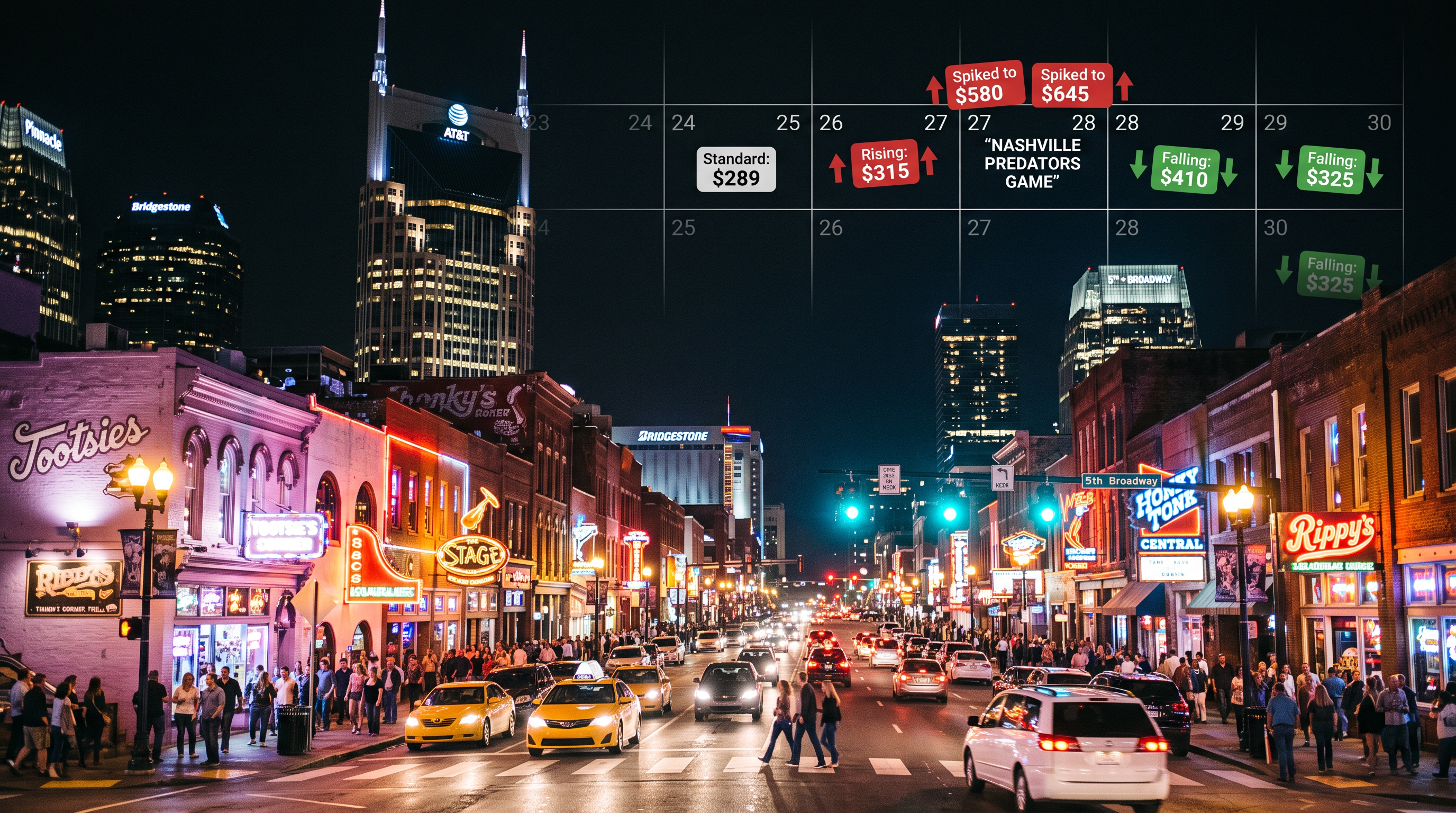
October in Nashville is a perfect test for your pricing automation. Titans home games, Bridgestone shows, and convention weeks stack on the calendar, then Halloween weekend lands with short booking windows. If you rely only on airbnb dynamic pricing tools, you will leave money on the table when real demand compresses by neighborhood and lead time.
- Audit how your tool builds rates, comps, and lead time curves, then localize it by neighborhood.
- Price CMA Fest and Titans Sundays with human overrides that reflect booking pace and trip type.
- Raise event-night floors, extend minimum stays, and price orphan nights deliberately.
- Measure overrides with RevPAR and pickup windows, not just occupancy.
- Use pacing alerts, comp filtering, and event tags, but do not let the algorithm smooth real spikes.
How Airbnb dynamic pricing tools set Nashville nightly rates
Most pricing engines predict demand from three inputs: historical seasonality, current market pacing, and comparable listings. Under the hood you will see day of week factors, lead time curves for each check-in date, and a comp set that drives your base and ceiling. Here is where things go sideways in Nashville.
- Comp selection, radius and property match: Tools often pull comps across the river or over I-40. A 3 bed in The Gulch, SoBro, or Broadway-adjacent supports a different ceiling than a similar home in East Nashville or The Nations, especially on event nights.
- Event detection, lag and smoothing: Algorithms flag big weekends when pacing jumps, but they smooth the spike so they do not miss for quiet years. Stacked events, for example Titans plus a sold-out arena show plus a medical convention, get underpriced because the tool averages to a safer middle.
- Lead time by trip type: Bachelor and bachelorette groups and large family trips often book far earlier than one-night leisure stays. If your tool applies one blended lead time curve, you lose early-bird premium on 3 to 5 bedroom calendars.
- Floors and caps, misaligned: Conservative global defaults keep floors too low and caps too close to base, which flattens premium dates instead of surging them.
Market context matters. Per AirDNA’s 2026 reporting, the average active listing generated about $39.2K annually at a $290 ADR, while year over year occupancy nudged up roughly 0.9 percent and RevPAR fell around 10 percent from May 2025 to May 2026. That tells you owners are filling nights but discounting harder than they should on rate strategy. Source: AirDNA Nashville overview.
PriceLabs vs Wheelhouse for Nashville event pricing
Both are strong. Both can miss Nashville’s fastest spikes without human help. Here is how to use each effectively.
Strengths you should actually use:
- PriceLabs, seasonal profiles and hyper-local comp filters: Build custom seasons for CMA, Titans home games, Predators opener, New Year’s Eve, and graduation weeks. Trim comps by bedroom count, review score, amenities, and map polygon, not a citywide radius.
- PriceLabs, tagging and min-stay rules: Use date-specific overrides to enforce 3 to 4 night minimums for CMA and 2 night minimums for key football weekends. Pair with far-out markups, for example +25 percent at 120 to 180 days for large groups.
- Wheelhouse, pacing and forecast views: Watch listing-level pacing vs past years and vs comp set. This is your early warning that an event is hotter than the model expects.
- Wheelhouse, aggressive last-minute ladders: Build structured markdowns for sub 7, sub 3, and same-day windows, but protect floors on event nights so the markdown ladder never undercuts a premium date.
Where both still miss in this city:
- Stacked-weekend compression: Tools tend to treat a Titans Sunday as a one-factor uplift. Add an arena sellout plus a convention and the ceiling jumps in a way the default curves do not fully capture.
- Neighborhood ceilings: Downtown and Gulch ceilings outpace East Nashville or Donelson on the same event by hundreds of dollars. One blunt uplift across the city is wrong.
- Orphan-night logic: Default rules chase occupancy, not profit. A Saturday orphan between two 3-night bookings should price at a premium, not a discount.
Want to see what your property could earn? Use our free Nashville STR Revenue Calculator to get a personalized forecast.
How to price an Airbnb for CMA Fest and Titans weekends
This is where human override pays. Use concrete multipliers, lead time gates, and minimum stays that reflect where your home sits and who books it.
CMA Fest, June each year
- Minimum stay: 3 to 4 nights. Set penalties for gaps that would create a 1-night hole.
- Lead time markup: Add +20 to +35 percent for bookings 120 to 240 days out for 3 to 5 bedroom homes. Groups plan early.
- Neighborhood ceilings: Downtown, SoBro, The Gulch and Broadway-adjacent often support 2.0 to 2.5 times base ADR if quality and capacity are there. Germantown and Music Row, 1.6 to 2.1 times. East Nashville, Wedgewood-Houston, and The Nations, 1.3 to 1.7 times. If your everyday ADR is $300, that means $600 to $750 downtown is common for well-reviewed 2 to 3 bedrooms, with larger units higher.
- Floors and caps: Set an event floor at 140 to 160 percent of base and a cap high enough to accept late compression, for example 260 to 300 percent of base for top locations.
Titans home Sundays, September to January
- Minimum stay: 2 nights for most units. Downtown condos and townhomes by Nissan Stadium can run 2 to 3 nights if Sunday is likely to produce an orphan otherwise.
- Lead time: Business travelers and fans mix. Keep a smaller far-out markup, +10 to +20 percent at 30 to 90 days, then monitor pacing.
- Uplifts: Downtown, SoBro, Germantown and East Bank pockets 1.2 to 1.6 times base for the Saturday to Monday window. East Nashville, Donelson, and Sylvan Park 1.1 to 1.4 times. Adjust by bedroom count and walkability.
- Protect Saturday: If Sunday carries the premium, price Saturday within 10 to 15 percent of Sunday to encourage 2-night bookings that raise total revenue.
For a deeper take on how events and design interact with returns, see our Nashville STR comeback play and the 2026 investment playbook.
Why Airbnb smart pricing can flatten premium event nights
Owners ask if Airbnb smart pricing is enough. For normal weekdays it can be passable, but Airbnb smart pricing bad is a fair summary for major event weekends here. The built-in logic optimizes for fill rate, applies conservative caps, and uses a very wide comp lens. It tends to do three unhelpful things during peak demand: it keeps floors low, it limits surge even when pacing screams for more, and it sells out early at suboptimal ADR.
What you will notice: your listing books first in the comp set, your average stay length is shorter than you wanted, and your neighbors hold out and earn more. If you see that pattern, you need an override plan immediately.
Human override rules: minimum stays, orphan nights, and floor rates
Use the algorithm for 80 percent of dates. On the other 20 percent, tell it what to do. Here is the rulebook we use across event-heavy calendars.
- Minimum stays by event: CMA 3 to 4 nights, New Year’s Eve 2 to 3 nights, Titans Sundays 2 nights. For multi-bedroom party-friendly layouts, require a longer stay further out, then relax it inside 14 to 21 days.
- Orphan-night premiums: Any single Saturday or Sunday trapped between bookings should carry a 15 to 35 percent premium over the surrounding dates, not a discount.
- Event floors: Do not let last-minute ladders cut below 130 to 150 percent of base on event nights. Floors should ignore standard markdown rules.
- Lead time gates: Add far-out adders for large homes, then step down in tiers. Example: +25 percent at 180 to 120 days, +15 percent at 119 to 60, +5 percent at 59 to 21.
- Holdback and release: For top locations, briefly hold inventory by setting a firm cap and high floor, then watch pacing. Release more competitive pricing 10 to 14 days out if the market is truly soft.
- Comp pruning: Exclude low-review or out-of-neighborhood listings from your comp set. Reset comps quarterly, and always before the fall sports run and before CMA.
If permits are still pending for your property, handle that first, then come back to pricing. Here is a straightforward primer, From Permit to Five-Star.
A Nashville event pricing strategy that beats the default algorithm
This is the playbook we run portfolio-wide. It turns automation into a local advantage rather than a blunt instrument.
- Layer the event calendar: Tag every Titans home game, Predators opener, New Year’s Eve, CMA Fest, graduations, and any weekend where a major convention overlaps a stadium or arena event. Load these into your tool as custom seasons or date-specific overrides. That is Airbnb event pricing for Nashville done right.
- Segment by neighborhood and bedroom count: Downtown, SoBro, The Gulch, Germantown and East Bank get higher caps and floors than East Nashville, Donelson, or The Nations. Larger homes get earlier lead time adders.
- Build far-out and last-minute ladders: Far-out adders catch groups when they are willing to pay. Last-minute ladders clear remaining inventory on non-event dates without touching your protected event floors.
- Protect calendar shape: Set rules to avoid 1-night gaps during peak weeks. Prefer 2 to 3 night patterns that raise total revenue even if the nightly ADR is slightly lower.
- Use pacing alerts: In PriceLabs vs Wheelhouse, enable notifications when your listing is pacing faster or slower than comps for a specific date range. If you are selling out too early for an event, raise caps and floors immediately.
- Review after action: After each event, export actuals. Note what sold at what lead time, which nights sold last, and where you underpriced. Bake that back into next year’s event profile.
If occupancy is fine but revenue still lags, it is not always rates alone. Your listing can be the drag. Cross-check with this teardown, why your Nashville Airbnb is not getting booked.
How to tell if your pricing override improved RevPAR
Measure results like an operator, not a hobbyist. Here is a simple, repeatable method.
- Define the test window: For example, CMA Thursday to Sunday, or a Titans Saturday to Monday. Compare this year’s performance to last year’s same weekend, adjusted for any material listing changes.
- Track pickup windows: Record the booked date for each reservation. If more revenue shifted to earlier, higher-ADR bookings, your lead time adders worked.
- RevPAR math: Sum revenue for the test window, divide by total available nights. Compare to the tool’s suggested rates and to your chosen comps. If RevPAR rose while occupancy held within 5 points, the override was a win.
- Watch sell-out order: If you sold last among quality comps and had to discount late, your caps were too high or floors too rigid. If you sold first by weeks, your ceilings were too low.
- External context: Check market trendlines. If the market’s RevPAR dipped, a flat result for you might still be an outperform. AirDNA’s seasonality view can provide context for macro softness.
How do Airbnb dynamic pricing tools work for Nashville rentals?
They blend historical seasonality, current booking pace, and a comp set to suggest a nightly rate for each future date. The catch in this city is stacked events and hyper-local ceilings. Without human rules for floors, minimum stays, and event tags, the algorithm smooths spikes and sells premium nights too cheaply. Use the tool for baseline shape, then override where local demand breaks the model.
Is Airbnb smart pricing bad for event weekends?
It is not built for stacked-event compression, so it often underprices premium dates and sells out early. You can keep it for weekday filler, but protect event calendars with stronger floors, longer minimum stays, and neighborhood-specific caps. If your listing is the first to book for a big weekend, you likely underpriced.
What is the best way to price an Airbnb for CMA Fest?
Set a 3 to 4 night minimum, load far-out markups for groups at 120 to 240 days, and raise event floors to at least 140 to 160 percent of base. Downtown and Gulch homes can support 2.0 to 2.5 times base ADR, with Germantown and Music Row slightly lower and East Nashville lower still. Protect against 1-night gaps and revisit caps weekly as pickup accelerates.
PriceLabs vs Wheelhouse, which is better for Nashville?
Both can win if configured well. PriceLabs shines with custom seasons and granular comp filtering. Wheelhouse shines with pacing dashboards and flexible markdown ladders. The difference maker is human configuration, event tagging, and neighborhood-specific floors and caps, not the brand name.
When should I override my Airbnb pricing tool?
Override on event weeks, when pacing runs hotter than the forecast, when your listing is booking first among comps, or when the tool would create a 1-night orphan during a peak period. Also override when you see lead time misalignment, for example large-group dates selling far out at too-low ADR. In short, when to override dynamic pricing is anytime the model ignores real, local demand signals.
How do you set minimum stays for event weekends?
Match stay rules to demand shape and location. For CMA, use 3 to 4 nights and relax to 2 nights inside 14 to 21 days. For Titans home games, use 2 nights, and keep Saturday and Sunday priced close to push 2-night bookings that raise total revenue. Downtown may support longer minimums than outer neighborhoods.
How can I tell if dynamic pricing is hurting RevPAR?
If you sell out far earlier than quality comps and your achieved ADR lags theirs, the tool is too soft. If you are discounting hard in the final week to clear inventory on non-event dates, floors and ladders need work. Compare your RevPAR on target weekends to last year and to comp sets, and monitor pickup windows to see where revenue is being won or lost.
Serious about lifting revenue on your calendar, not just filling nights? Get your free Nashville revenue estimate, then Schedule a call with our team to see how our event-aware automation and human overrides outperform default settings at scale.