Beyond Airbnb, Listing on Multiple Booking Sites in Nashville
Learn how listing on multiple booking sites can raise Nashville occupancy while a channel manager keeps rates and calendars synced. Built for Nashville…
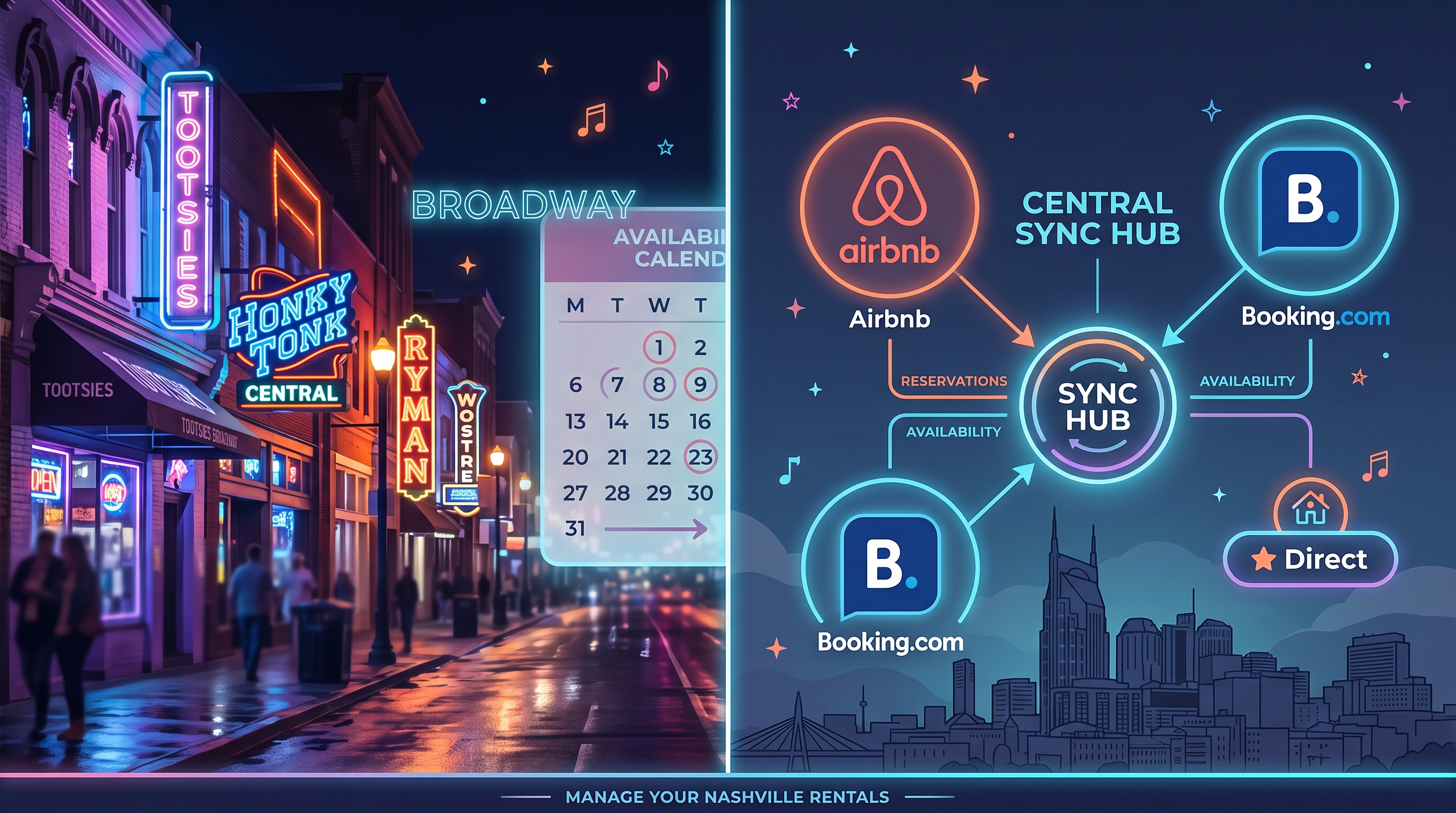
Peak weekends are about to compress again in Nashville as Titans home games and arena tours stack onto fall convention traffic. AirDNA shows occupancy hovering near 54 percent citywide and RevPAR down year over year in late spring, which means distribution and pricing discipline decide your next 10 percent of revenue. If you are only on Airbnb, listing on multiple booking sites is the fastest lever to catch guest segments you are missing without redesigning your property.
- Quick take:
- Match channels to your property type, not vibes. Groups and families skew to Vrbo, urban short stays skew to Booking.com.
- Adopt a real API-connected channel manager, then map rates, fees, and minimum-stay rules before you ever go live.
- Stand up a direct site to convert repeats and review traffic, then remarket to them during high demand windows.
- Expect a measured lift, often 2 to 8 occupancy points when multi-channel is implemented cleanly, with bigger gains for larger homes.
- Protect the calendar with instant blocks, short lead-time rules, and payment validation across every channel.
Why listing on multiple booking sites matters for Nashville STRs
Nashville demand is event heavy and spiky. According to AirDNA’s 2026 Nashville overview, the market sits near 13,900 active listings across Airbnb, Vrbo, and Booking.com, with average occupancy around 54 percent. From May 2025 to May 2026, occupancy ticked up slightly while RevPAR fell. Translation, more calendars looked full, but at softer pricing. Multi-channel distribution is not about vanity exposure. It is about catching distinct guest segments on the dates where they shop, then letting your pricing engine do the sorting.
Where this really pays in Nashville:
- Compression weekends: CMA Fest in June, big concert runs, Titans home Saturdays and Sundays, and New Year’s Eve. Extra reach matters when guests are searching anywhere they can find inventory.
- Shoulder weekdays: Fall midweeks can sag even when weekends sell out. Booking.com’s short-stay, last-minute audience can backfill 1 to 2 night gaps if your rules allow it.
- Return traffic: Guests who loved your place for a bachelorette weekend or a family trip will book direct next time if that path is obvious and frictionless.
Airbnb vs Vrbo, which gets more bookings for your property type
The answer depends on beds, location, and stay length. Here is how it usually shakes out in Nashville.
- 1 bedroom or studio, walkable to Downtown or The Gulch: Airbnb is often the discovery engine. Booking.com can add last-minute midweeks. Vrbo rarely leads here unless you are unusually spacious or have parking.
- 2 bedrooms in Germantown, 12 South, or Wedgewood-Houston: Airbnb still leads, but Vrbo picks up multi-night family stays and friend groups who prefer private homes. Booking.com is a gap filler for short business or event stays.
- 3 to 5 bedrooms in The Nations, East Nashville, Donelson, or Sylvan Park: Vrbo pulls stronger with families and groups planning 3 to 5 nights. Airbnb remains critical, but do not sleep on Vrbo’s family-first filter set and guests who plan further ahead.
- Large group-friendly homes with bunks and parking: Vrbo wins more first touches and converts longer stays. Airbnb stays essential for volume, but expect a more balanced split.
If you want the shortest version of airbnb vs vrbo which gets more bookings, match the channel to your guest’s planning style. Short stays and experiences browsing, Airbnb and Booking.com. Longer stays and multi-generational trips, Vrbo. Then let dynamic pricing steer the rate and minimum-stay by date.
Want to see what your property could earn? Use our free Nashville STR Revenue Calculator to get a personalized forecast.
How a channel manager for short term rental keeps calendars and rates synced
Calendars break when you rely on iCal. Feeds can lag for minutes or longer, which is an eternity during compressed searches. A vacation rental channel manager with full API connections pushes blocks and pricing in near real time, centralizes messaging, and normalizes policies so you are not maintaining five rule sets by hand.
What to sync beyond just dates
- Rates: Push nightly rates from your pricing engine to every channel, including markups to offset each platform’s commission. Many operators add 3 to 8 percent to Booking.com and 2 to 5 percent to Vrbo to keep net rate parity with Airbnb.
- Minimum-stay and day-of-week logic: Separate weekend and weekday minimums, plus event exceptions. Map these, do not assume every channel reads them the same way.
- Orphan-night rules: Your pricing engine can auto-drop the minimum on single gap nights and raise the rate. Confirm the channel manager actually forwards those overrides.
- Fees and taxes: Cleaning, extra guest, pet, and parking fees must be named and mapped channel by channel. Mislabel a fee on Booking.com and you will eat it.
- Cancellation and deposit policies: Use consistent names and mirrors. Booking.com often wants a rate plan per policy, so plan the structure before you connect.
API vs iCal
- API connections: Two-way, near real-time blocks and pricing, unified messaging, and full inventory control. This is the standard for serious operators.
- iCal feeds: Read-only or delayed. Fine for a spare room, not fine for an asset that loses hundreds on a double-booked Saturday.
Budget roughly $10 to $25 per listing per month for a capable channel manager, plus payment processing and any direct-site hosting. The software should save you hours weekly and prevent the one calendar mistake that wipes out the year’s subscription.
What a direct booking site for Airbnb adds to repeat guests
A direct booking site for Airbnb hosts is not about replacing OTAs. It is a conversion trap for guests who already trust you. In Nashville, repeat bachelorette groups, family reunion planners, and convention attendees booked last year are prime candidates to return without OTA fees.
What the site must include
- Real-time availability and checkout: Do not make guests inquire. Instant book with verified payments or they will bounce back to an OTA.
- Payment and fraud controls: 3D Secure where available, card checks, and automated ID verification for higher-risk bookings.
- Clear policies: Mirror your OTA cancellation and house rules so guests do not feel punished for booking direct.
- Remarketing engine: Capture emails during and after OTA stays, then send time-bound offers around key weekends or midweek gaps.
How to drive traffic to it
- Post-stay flows: Automated message sequences and a final receipt that links the direct site for next time.
- In-home prompts: A tasteful QR code in the house manual and a checkout card that thanks them and offers a small repeat-book credit.
- Search and social: Branded searches plus lightweight retargeting aimed at drive markets inside 6 hours.
Expect hosting costs of $30 to $80 per month for a polished direct site, plus 2.9 percent payment fees. Even a handful of direct repeats can cover that within one quarter.
How to prevent double booking Airbnb Vrbo mistakes
Calendar mistakes cost the most during event compression. Build guardrails that make a double booking improbable, then rare, then basically impossible.
- Use API, not iCal: Connect Airbnb, Vrbo, and Booking.com via API through your channel manager. Reserve iCal only for niche sites.
- Instant block on quote: Some managers can place a temporary hold when a guest starts checkout. If your tool supports it, turn this on for peak weekends.
- Short lead time for same-day and next-day: Set a booking cutoff of 8 to 12 hours for last-minute arrivals so cleaning and messaging can keep up.
- Auto-buffer for turn days: Insert a 3 to 5 hour prep window on both sides of every turnover so overlapping check-in times do not collide across channels.
- Single source of truth for pricing: Price changes originate in one engine, then push out. Never hand-edit rates on a channel unless it is a true exception.
- Payments first: Require valid payment and ID before confirming non-OTA direct bookings. This prevents phantom holds that block revenue dates.
- One calendar override procedure: If staff ever has to move or cancel a booking, document the exact steps and who performs them. Ad hoc fixes create the next mistake.
If you are wondering how to avoid double bookings on Airbnb and Vrbo, the answer is boring and effective. API sync, instant blocks on checkout, short lead-time rules, and clear overrides. When you do those four, the risk falls to rounding error.
What multi-channel actually adds to occupancy in Nashville
Here is what we see when distribution is implemented cleanly and paired with disciplined pricing. Your mileage will vary by location, photos, and reviews, but the pattern is consistent.
- Urban 1 bedrooms near Downtown or The Gulch: +2 to +4 occupancy points from Booking.com plus a small trickle of direct repeats. Most of the lift is on midweeks and single gaps.
- 2 bedrooms in Germantown, 12 South, WEHO: +3 to +6 points as Vrbo begins to contribute longer bookings while Booking.com catches late planners.
- 3 to 5 bedrooms in East Nashville, The Nations, Donelson, Sylvan Park: +4 to +8 points as Vrbo lands 3 to 5 night stays and direct channels convert repeats tied to annual events.
Math check on a typical home: if a 3 bedroom averages 54 percent occupancy at a $225 ADR and you add 5 points, that is about 18 extra nights per 365. At $225 ADR and 15 percent average channel cost, that is roughly $3,440 in net incremental room revenue before cleaning and variable costs. If your channel manager costs $20 per month and your direct-site stack $50 per month, the payback is measured in weeks, not years.
How to measure it like an operator
- Baseline by property: Record occupancy, ADR, RevPAR, and net margin for 60 to 90 days pre expansion.
- Roll out in stages: Add Vrbo first for larger homes, then Booking.com once rules and fees are mapped. Hold your direct site for repeat traffic after 1 to 2 months on OTAs.
- Watch net, not gross: Booking.com can add cancels and card issues if you misconfigure payments. Measure net RevPAR and cancellation rate by channel.
- Retarget repeats: Use emails gathered from past OTA stays to drive future direct bookings. That improves channel mix quality every quarter.
For fall tactics on pricing and compression dates, see our take on how to capitalize on fall revenue windows. If you want a broader operating framework, read the 2026 guide to Nashville vacation rental management success.
One note before you expand. Make sure your home is permitted for short-term rental where it sits, then run distribution. If you need a refresher, start here: From Permit to Five-Star.
How a channel manager for short term rental keeps calendars and rates synced
Let us get more tactical on setup steps that protect your time and returns.
- Inventory map: One listing per space, named consistently across channels. Avoid clones and duplicates that desync instantly.
- Rate plan design: Create base, non-refundable, and event rate plans only if your channels require them, or you will triple your maintenance.
- Fees and taxes audit: Do a live test on each OTA cart. Confirm cleaning, pet, extra guest, and parking fees are included exactly once.
- Policy parity: Mirror cancellation and deposit rules. If you loosen one channel for a promo, put a calendar reminder to revert it.
- Messaging templates: Automate booking confirmation, pre-arrival, house manual, and checkout flows. Keep the same tone on every channel.
- Escalation rules: For same-day bookings, require a phone number and validated payment before door codes go out.
When your distribution stack is humming, it hands you back hours every week. If you are weighing full-service help, here is a broader look at ROI: Is Nashville vacation rental management worth it in 2026.
Related: See more Nashville STR insights | Explore how we run operations.
Next step
If you want a risk-aware plan for permits, pricing, and operations in Nashville, I’ll walk you through it quickly and candidly.
Serious about squeezing more from your calendar without adding headaches? Get your free Nashville revenue estimate, then schedule a call to see how we set up channel management, pricing, and direct booking the right way.
Serious about squeezing more from your calendar without adding headaches? To see how we set up channel management, pricing, and direct booking the right way, schedule a call after getting your free Nashville revenue estimate.
FAQ
Should I list my Nashville Airbnb on Vrbo and Booking.com too?
Yes, in most cases. Nashville’s event-driven demand rewards listing on multiple booking sites, especially if you pair it with API-level sync and strong pricing rules. Expect a small lift for 1 bedrooms and a larger lift for 3 to 5 bedroom homes that attract families and groups. The key is measuring net RevPAR and cancellation rates by channel, not just gross nights.
Airbnb vs Vrbo, which gets more bookings in Nashville?
For small urban units near Downtown and The Gulch, Airbnb usually leads and Booking.com adds last-minute midweeks. For larger homes in East Nashville, The Nations, Donelson, or Sylvan Park, Vrbo often wins longer family and group stays. The best result comes from using both, then letting dynamic pricing and minimum-stay logic route demand by date.
What does a channel manager do for short-term rentals?
It is the hub that keeps calendars, rates, rules, and messaging aligned across Airbnb, Vrbo, Booking.com, and your direct site. A good tool pushes blocks and pricing in near real time, maps fees correctly, and standardizes policies so you are not copy-pasting rules in five dashboards. It also reduces double-book risk and gives you one inbox for guest communication.
How do I avoid double bookings on Airbnb and Vrbo?
Use API connections through a channel manager rather than iCal feeds, and turn on instant blocks when a guest starts checkout if your tool offers it. Set short lead times for same-day bookings, add a small buffer around turnovers, and require verified payment before confirming direct reservations. Those four steps eliminate almost all double booking airbnb vrbo headaches.
Do direct booking sites really increase Airbnb profits?
Yes, when they focus on repeat guests and review traffic that already trusts your brand. Even a few direct repeats per quarter can cover hosting and processing costs, and they reduce dependency on OTA algorithms. Keep policies consistent with your OTA listings and make checkout frictionless so guests feel safe booking direct.
How many booking sites should a Nashville STR be on?
Most properties perform best on two to three channels plus a direct site. For 1 bedrooms, that is usually Airbnb and Booking.com. For 3 to 5 bedrooms, it is Airbnb and Vrbo. Add your direct site for repeats once your OTA presence is stable and measured.
Serious about squeezing more from your calendar without adding headaches? Get your free Nashville revenue estimate, then schedule a call to see how we set up channel management, pricing, and direct booking the right way.
Next step
If you want a risk-aware plan for permits, pricing, and operations in Nashville, I’ll walk you through it quickly and candidly.
Serious about squeezing more from your calendar without adding headaches? Get your free Nashville revenue estimate, then schedule a call to see how we set up channel management, pricing, and direct booking the right way.