Why Self-Managing Nashville Airbnb Costs You RevPAR in 2026
Discover the hidden costs of self-managing a Nashville Airbnb, including utilities, cleaning, and permit fines that erode your $156 RevPAR. Learn why…
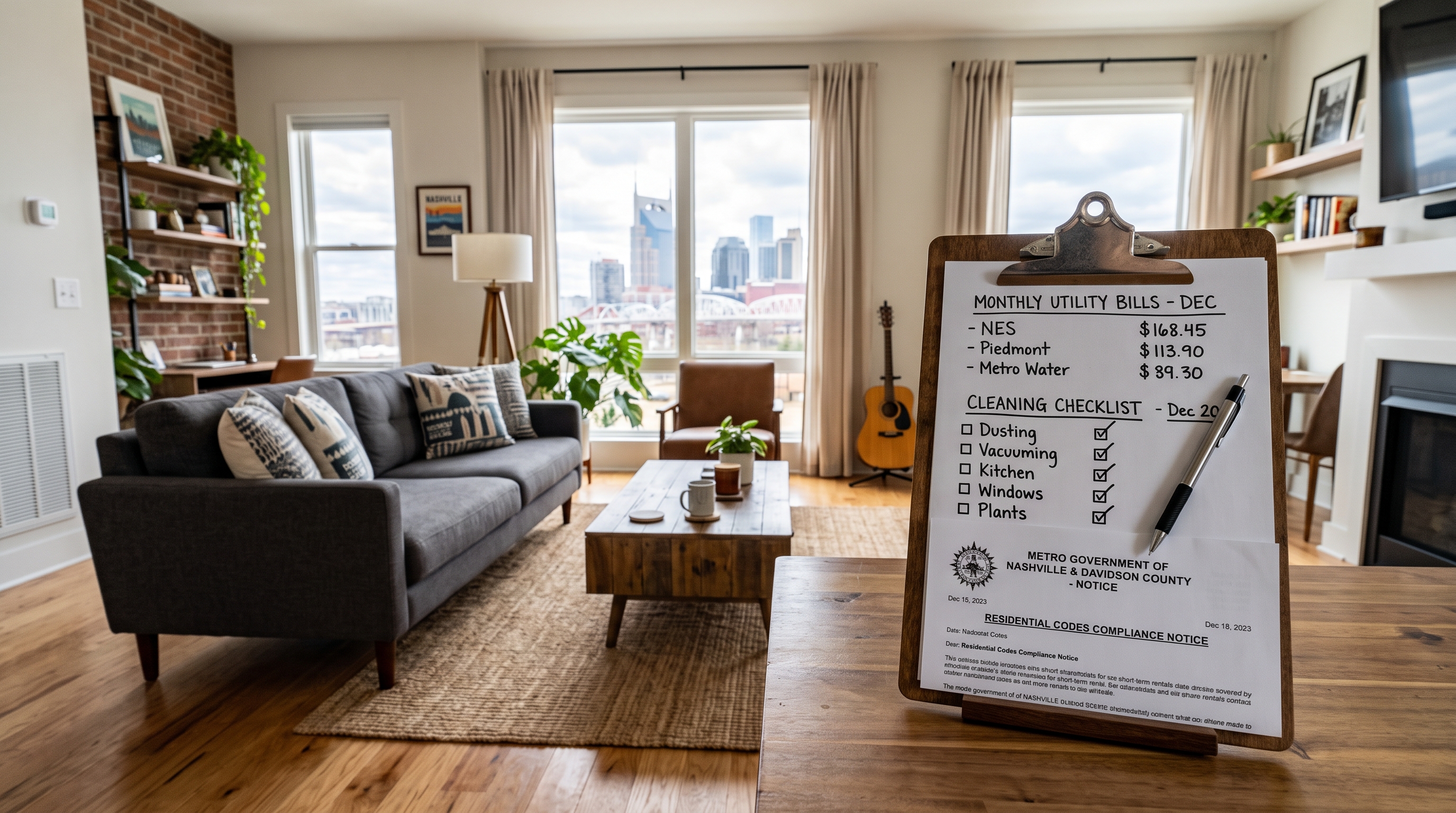
Mid July 2026. CMA Fest cleared out last month, and weekday demand has slipped into the summer shoulder while enforcement stays visible around downtown and the East Bank. With booking windows compressed to about 22 days this year and supply down from the 2025 peak, owners tallying self-managing Nashville Airbnb costs against a citywide RevPAR near $156 are finding that small leaks add up fast.
Quick take:
- Quantify every line item, not just cleaning and platform fees, then benchmark it against your RevPAR and occupancy.
- Control utility burn with HVAC rules, smart thermostats, and laundry policy, or you will give back 5 to 10 percent of gross.
- Use dynamic pricing tuned to 0 to 6 and 7 to 13 day windows, or last-minute guests will book your neighbor instead.
- Treat compliance like a profit center: quiet hours, sensors, guest screening, and fast response prevent costly refunds and permit risk.
- Decide if your time is free. If you spend 8 to 12 hours a week in-season, price that into your true net.
The Real Cost Breakdown of Self-Managing a Nashville Airbnb in 2026
Two things define 2026. First, active listings contracted from more than 10,100 last year to about 9,812 by January, according to a January market report. Second, the median booking window tightened to roughly 22 days, with most bookings inside two weeks. That shift exposes operational drag. When RevPAR averages about $156 across the market, per AirROI, every unmanaged cost shows up in your net.
Fixed and semi-fixed costs you carry even when nights do not sell
- Utilities: electric, water and sewer, gas, internet.
- Software: pricing tool, channel manager, noise monitoring, smart lock platform.
- Insurance: STR policy, liability, umbrella if applicable.
- Permit and inspections: renewals and periodic life-safety checks.
- Maintenance: HVAC service, pest control, handyman visits, small appliance replacement.
Per-stay costs that scale with occupancy
- Turnover labor and laundry, consumables, damage and missing item replacement.
- Manager time, guest messaging, claims handling, supply runs.
- Refunds, discounts, and re-cleans when issues pop up.
In The Nations, Germantown, and East Nashville, a 3 bedroom townhome that sleeps 8 to 10 will feel these inputs more than a 1 bedroom in The Gulch. Bigger groups mean more laundry, more utilities, and higher wear, but they also capture premium event weekends and can hold ADR. The point is simple, align your expense playbook with your unit type and guest mix.
How Rising Utility and Cleaning Fees Erode Your Nashville Airbnb RevPAR
Utility and turnover inflation is real. Here are 2026 ranges we are seeing on like-kind homes around the core, the kind of Nashville STR utility costs that quietly erode margin if you do not control them.
Utilities, realistic monthly ranges on a 3 bedroom townhome
- Electric: 220 to 360 dollars in summer with rooftop decks and heavy A/C usage, 180 to 300 dollars in winter.
- Water and sewer: 90 to 140 dollars, spikes with full-house weekends and longer hot showers.
- Gas: 40 to 100 dollars when water heating or heat is on gas.
- Internet: 70 to 100 dollars for 1 Gbps service to support streaming and work calls.
Across a year, that footprint often lands near 5,500 to 6,500 dollars before you replace a single sheet or towel. You can cut 10 to 15 percent of HVAC load with 72 to 74 degree setpoints, two-stage recovery schedules, and auto-locking thermostats that hold settings between stays.
Cleaning, laundry, and the math of short stays
Nashville Airbnb cleaning fees 2026 generally run 150 to 220 dollars for a 2 bedroom, and 180 to 260 dollars for a 3 bedroom, assuming standard laundry and no deep-clean tasks. Add 40 to 80 dollars if you have multiple duvet systems or heavy makeup and glitter removal after bachelorette groups. Owners often pass these fees to guests, but the market punishes high cleaning on 1 to 2 night stays. If you drop base rate to win a short midweek, you are subsidizing turnover even if the fee is technically paid by the guest.
Pro move: Create a weekday short-stay subsidy rule set. If a 1 night gap appears inside 5 days, reduce the cleaning line item 20 to 30 dollars and raise nightly rate 10 to 15 dollars so the total feels fair. You will pick up orphan nights without training guests to expect deep discounts.
Want to see what your property could earn? Use our free Nashville STR Revenue Calculator to get a personalized forecast.
Noise complaints are worth heading off with monitoring and clear house rules, both because they sour reviews and because they put your permit at risk. Our Nashville STR permit guide covers the enforcement side.
Why Self-Management Underperforms When Booking Windows Compress to 22 Days
This year, the booking curve moved inside three weeks, with most pickups happening in the 0 to 13 day bands per January market reporting. Static pricing and once-a-week rate checks miss that window. Short lead times reward aggressive, data-driven tactics, not hunches.
What nimble revenue management looks like
- Daily price scans against a tight comp set filtered by bedrooms, guest capacity, and walkability to Broadway or 12 South.
- Inside-10-day markdown ladder in small steps, 3 to 7 percent, instead of single big cuts that train shoppers.
- Gap-fill and orphan-night rules that loosen minimum stays midweek while holding 2 to 3 nights on weekends.
- Event week fences, for example, hold a 3 night minimum in a 2 mile core around Nissan Stadium for Titans home games, but open shorter stays the Monday after big weekends.
Our full 2026 playbook for these shifts is broken down in the Nashville STR Comeback Play guide and the 2026 Investment Playbook. They show how to move from average to top quartile without over-discounting.
Comparing Self-Management vs. Professional Management for Nashville STRs
Self-management is not free. Even if you assign zero value to your hours, your vendor rates, response coverage, and revenue tools decide your net. Here is the practical comparison.
Where professional operators usually outperform solo owners
- Labor cost, vendor network: Bulk cleaning, linen service, and maintenance rates often run 10 to 20 percent lower with a vetted bench. That is real money across 50 to 70 turns a year.
- Speed and coverage: 24 by 7 guest help and field dispatch cuts refunds, avoids retaliatory reviews, and prevents claim denials.
- Revenue lift: Purpose-built pricing, better photos, and listing SEO add 5 to 15 percent, sometimes more on larger group homes near The Gulch, Wedgewood-Houston, or 12 South.
- Compliance, documentation: Pro-grade house rules, sensor policies, and neighbor comms keep you out of the penalty box when enforcement tightens.
Where owners can keep control and still win
- Design and capex decisions. Choose durable sofas, zipper encasements, and towel inventory sized to 1.5 to 2 turns without mid-stay laundering.
- Guest experience touches. Stock regional coffee, a quick local guide, and an arrival video. Small details add review velocity.
- Portfolio strategy. Decide if you want high-ADR group homes or simpler 1 to 2 bedroom units with steadier midweek demand.
For a fee structure discussion and what you get at each level, see Is Nashville Vacation Rental Management Worth It in 2026.
Calculating Your True Net Income: Self-Managed Nashville Airbnb Scenario
Let us run the numbers on a typical 3 bedroom row home that sleeps 10 in The Nations or Germantown. We will use market-wide data and conservative operator assumptions so you can slot in your own figures.
Starting point, market averages
- Annual gross revenue: 39,159 dollars, per AirROI 2026 dataset.
- RevPAR: 156 dollars, same source.
- ADR and occupancy vary by neighborhood and number of bedrooms, but local reports show ADR in the low to mid 300s with mid-40s occupancy trending for 2026.
Operating costs you pay before mortgage and capex
- Utilities: about 6,000 dollars per year combined for electric, water and sewer, gas, and internet, with smart controls in place.
- Supplies and amenities: 1,500 dollars per year for coffee, paper goods, toiletries, welcome items.
- Linen replacement and smallwares: 900 dollars per year.
- Insurance: 1,600 dollars per year for an STR-specific policy.
- Permit and inspections: 150 dollars per year set aside for renewals and tune-ups.
- Software stack: 1,200 dollars per year for pricing, channel, locks, and monitoring.
- Accounting and licensing: 300 dollars per year.
- Maintenance reserve: 2,000 dollars per year for handyman calls and minor replacements.
- Pest control: 420 dollars per year.
- Deep cleans: 1,600 dollars per year for quarterly detail work.
- Platform and processing fees: about 1,175 dollars per year at 3 percent on the revenue above.
- Short-stay cleaning subsidy: 1,400 dollars per year to stay competitive on 1 night midweek gaps.
Tally: roughly 18,300 dollars in annual operating spend before mortgage, property tax, or depreciation. Against 39,159 dollars in gross, your operating net lands near 20,800 dollars. That is your cash cushion before any big-ticket repairs.
The cost you probably are not counting
Time. If you average 8 to 12 hours a week in peak months and 5 to 6 hours off-peak, you are near 520 hours a year. Value your time at 40 dollars an hour and the effective cost is about 20,800 dollars, which mirrors the operating net in this scenario. That is why so many owners feel busy but cash poor.
If your RevPAR is 156 dollars and your fixed burn is 1,200 to 1,500 dollars a month before you sell a single night, you must run a tight, fast operation or your margin will disappear in small leaks.
When to Switch from Self-Management to Full-Service Nashville STR Management
There is a point where your time, risk, and scale tip the balance. Here are the triggers we see most often.
- You operate two or more group homes, 3 bedrooms and up, with overlapping Saturday turns.
- Your weekday occupancy is soft and your last-minute pickup rate is below comp set peers by more than 5 points.
- Neighbor or HOA tolerance is thin and repeat noise pings are showing up on event weekends.
- You are replacing linens and smallwares every 60 to 90 days due to loss or damage, which suggests process gaps a pro team can close.
- Your pricing tool is set-and-forget and you are not adjusting minimum stays or orphan logic inside two weeks.
If this sounds familiar, trade a management fee for lower unit costs, better rates, and real coverage. That is how you grow net, not just gross. For more tactic detail, see our fall optimization strategies and revenue maximization hacks.
The Real Cost Breakdown of Self-Managing a Nashville STR in 2026
To close the loop, put your own numbers next to these line items. You will likely see three truths. First, rising utilities and cleaning push fixed burn higher each year. Second, compressed lead time punishes slow pricing decisions. Third, enforcement risk is a revenue variable you can control with the right systems. The owners who win in 2026 focus on Nashville Airbnb RevPAR optimization and cost discipline at the same time.
Action checklist for the next 30 days
- Audit last quarter refunds and discounts, categorize by root cause, and fix the top two drivers.
- Install or tighten thermostat schedules and lock ranges, then verify with remote monitoring.
- Rebid your cleaning and laundry, or move to a linen program that reduces rewash time and losses.
- Reset pricing rules for 0 to 6, 7 to 13, and 14 to 21 day windows through September, then review weekly.
- Document a noise escalation protocol and save three templates in your inbox.
FAQ
How much does it cost to self-manage an Airbnb in Nashville?
On a typical 3 bedroom, annual operating spend before mortgage often lands around 16,000 to 20,000 dollars, with utilities, software, maintenance, deep cleans, and platform fees leading the list. That excludes your time, which can match your operating net if you account for it. The exact figure varies by neighborhood, size, and guest mix, but the pattern is consistent when you stack up self-managing Nashville Airbnb costs against market-average RevPAR. Run your numbers line by line, then compare to what a professional can deliver on rate and expense.
What are the average utility costs for a Nashville short-term rental?
For a well-run 3 bedroom, expect roughly 5,500 to 6,500 dollars a year combined for electric, water and sewer, gas, and internet. Rooftop decks, older HVAC, and high-occupancy weekends push you to the top of the range. Smart thermostats, tighter laundry policies, and routine HVAC service are the fastest levers to pull costs down.
How much are cleaning fees for a Nashville Airbnb per stay?
Standard turns typically price at 150 to 220 dollars for a 2 bedroom and 180 to 260 dollars for a 3 bedroom, with higher rates when laundry volume, duvets, or glitter-heavy cleanups are involved. Guests often pay the cleaning fee, but for 1 night gaps you may need to subsidize a portion to stay competitive. Model that subsidy into your pricing rules rather than discounting ad hoc.
How much RevPAR does self-managing actually cost?
The gap usually lands between 15% and 30% of RevPAR, from three places: static pricing that misses event weeks, slow inquiry response that loses bookings to faster hosts, and minimum-stay rules that block short gap-fillers. None of those appear on a monthly statement, which is why the cost goes unnoticed.
Does self-managing a Nashville Airbnb lower my occupancy rate?
It can if pricing and response times lag the market. With the median booking window around 22 days this year, daily pricing, fast inquiry handling, and flexible minimum stays inside two weeks are critical. Owners who check rates weekly often miss the last-minute surge and lose share to listings that adjust faster.
What is the fastest fix for a self-managing Nashville owner?
Turn off Airbnb Smart Pricing and set an event-aware calendar of your own. Nashville demand spikes around CMA Fest, NFL home games, and bachelorette season, and the platform default consistently underprices those windows while overpricing the quiet weeks between them.
Is professional management worth it for a Nashville Airbnb in 2026?
If a pro can lift revenue 5 to 15 percent and reduce unit costs 10 to 20 percent through vendor rates and process control, the fee can pencil, especially on larger homes. The math gets clearer when you price your time and risk. In a year with tight booking windows and higher operating costs, turning margin into protected net income is the goal.
Serious about your numbers and ready for less guesswork. Get your free Nashville revenue estimate, then Schedule a call to see how a professional operation can turn RevPAR into durable profit.