Where Nashville non-owner occupied STR zoning still works
New non-owner occupied STR permits are banned in Nashville residential zones. Learn which mixed-use zones (MUN, MUL, MUG) still allow investor Airbnb permits.
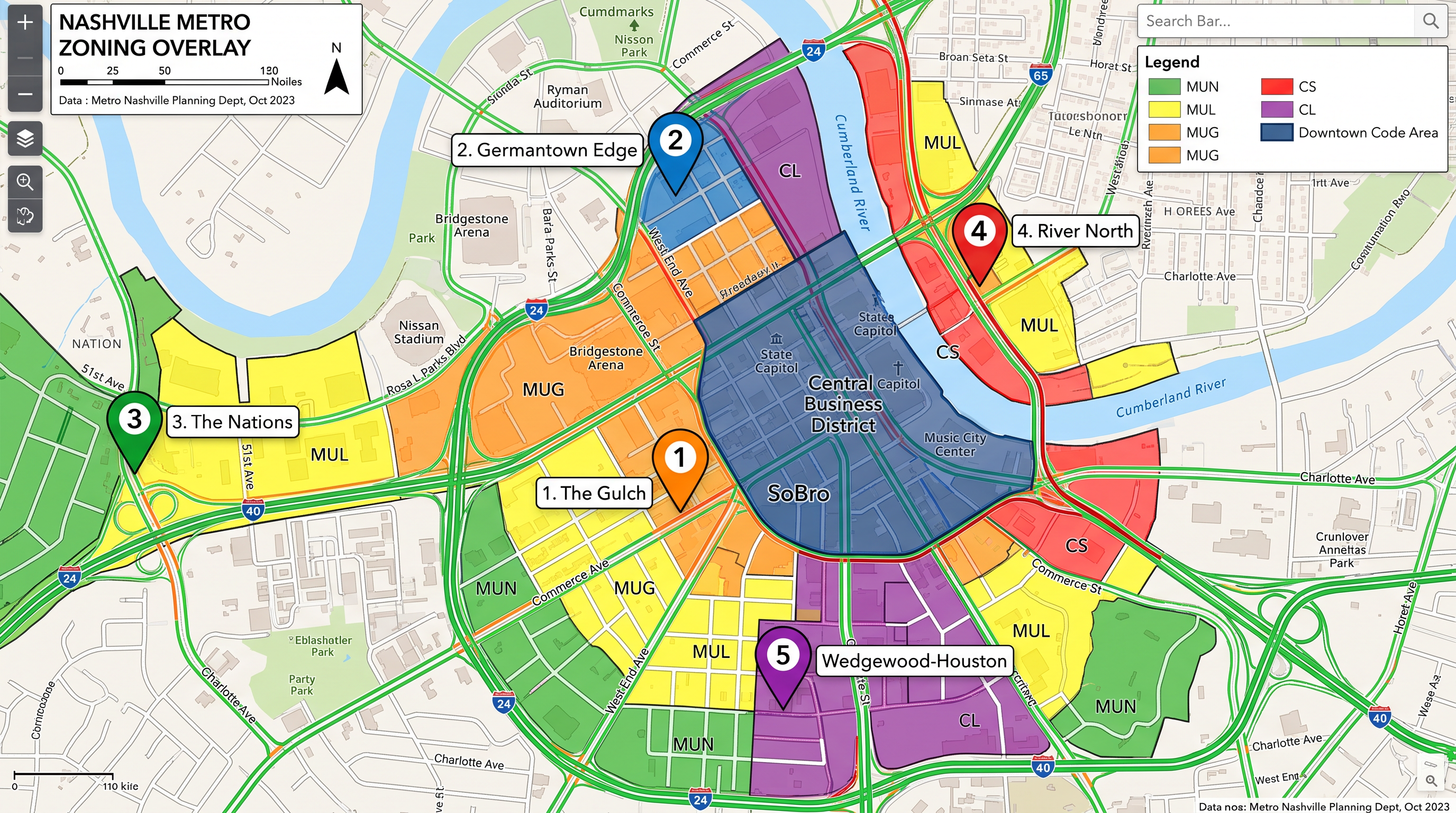
Summer 2026 has made one thing clear. If your agent is still calling an R or RS lot "STR-friendly," you are being set up for a denial. If you are searching for Nashville non-owner occupied STR zoning, the path to a new investor permit now runs through mixed-use and commercial districts, not residential streets.
- Quick take:
- Confirm base zoning first, do not rely on listing language or hearsay.
- Target MUN, MUL, MUG, DTC, CL, and CS, then vet overlays and HOA rules.
- Expect stricter enforcement, plan for occupancy, parking, and life-safety from day one.
- Grandfathered residential NOO permits are premium assets, protect them with perfect compliance at renewal.
- Design for groups near the East Bank and River North, 3 to 5 bedroom layouts win on RevPAR.
Why residential zones no longer support new NOO STR permits in Nashville
Metro Council closed the door on new non-owner occupied permits in residential zones starting in 2022. If the base zoning on your parcel is R or RS, you cannot obtain a new investor STR permit in 2026. Owner-occupied permits may still be allowed in some residential areas, but those are not transferable and come with strict primary residence requirements. The short version, a residential lot marketed as STR-friendly for a new NOO permit is not going to pass.
There are two important exceptions to understand. First, some NOO permits issued in residential districts before the ban are grandfathered. Those permits are valuable, and they remain valid if you renew on time and keep the property in full compliance. Second, a site-specific SP can allow NOO use if the adopted plan explicitly permits it, but do not assume every SP does. Always verify the SP text and any associated conditions with Metro Codes.
For the city’s official permit categories, renewal rules, and general requirements, start with the Metro Codes short-term rental page. Read Metro’s STR guidelines here, then come back and use the steps below to ground-truth your parcel.
Which mixed-use zoning districts still allow non-owner occupied STRs in Nashville
Investors who want a new NOO permit in 2026 should focus on mixed-use districts where transient lodging is permitted by right or allowed as a short-term rental use. The three workhorses are MUN, MUL, and MUG. The differences matter for design, parking, and density.
MUN, neighborhood scale mixed-use
MUN supports smaller format mixed-use along walkable corridors. Think stretches of Gallatin Avenue and Main Street near 5 Points in East Nashville, or pockets along Dickerson Pike near Trinity Lane. Typical play, townhomes or flats over retail with 1 to 3 parking spaces per unit, and 2 to 4 bedroom footprints. MUN can work well for 6 to 10 guest listings when the building and HOA do not restrict STRs.
MUL, urban mixed-use with more intensity
MUL steps up height and intensity. You see MUL up and down Charlotte Avenue from Sylvan Park into The Nations, plus Nolensville Pike nodes and Murfreesboro Pike corridors. This is where 3 to 5 bedroom formats with 8 to 12 guest capacity tend to pencil, especially when stacked over ground-floor commercial. Proximity to Vanderbilt, Midtown, and event districts drives reliable weekend compression.
MUG, the gateway to core markets
MUG lives near the core, including edges of The Gulch, SoBro approaches, and River North. If you want the highest ADR potential without going full hotel, MUG is usually your best shot. Expect structured parking or shared garages, elevator buildings, and larger units. Group-friendly designs outperform here, and the East Bank stadium buildout should support this submarket over the next cycle.
Local market reports estimate roughly 3,700 active STR permits countywide in 2026, and new permits are concentrated in these mixed-use and commercial districts. On the performance side, AirROI reports about 3,194 active listings and a RevPAR near $156 in 2026, which aligns with what we see on the ground for compliant, well-run units. March 2026 occupancy and ADR also moved up versus 2025 according to local market reports, a sign that legal supply is tightening while demand remains healthy.
How to verify if your Nashville property is in MUN, MUL, or MUG zoning
Before you run pro formas, confirm the parcel’s actual codes and constraints. Here is the sequence our team uses when evaluating a deal.
- Pull the parcel record in Metro’s Property Viewer or your title report, note the base zoning letters. You are looking for MUN, MUL, MUG, DTC, CS, or CL. R and RS are a hard stop for new NOO permits.
- Check overlays. DTC subdistricts, Urban Zoning Overlay, historic overlays, or a Site Plan SP can add use conditions, height caps, or design rules. If it is an SP, get the adopted SP document and read the permitted uses line by line.
- Confirm HOA and building rules. Many condo declarations prohibit daily rentals regardless of city zoning. Ask for the recorded CCRs, bylaws, house rules, and any amendment history. Require written confirmation before you go hard on earnest money.
- Validate utilities and life-safety. Short-term rentals need hardwired smoke detectors in bedrooms and hallways, fire extinguishers, and sometimes sprinkler or alarm compliance depending on building type. If the building is not up to code, budget for upgrades before permit application.
- Document parking and access. Metro may ask for site plans, parking counts, and proof of access. Shared parking agreements and curb cuts should be recorded or explicitly allowed.
Want to see what your property could earn? Use our free Nashville STR Revenue Calculator to get a personalized forecast.
The difference between NOO and owner-occupied permits by zone type
Non-owner occupied permits are for full-time vacation rentals where no one claims primary residence. In 2026, they are limited to qualifying commercial and mixed-use zones. Owner-occupied permits are for primary residences where you rent rooms or the home while you are away for limited nights, with different rules, and they are often still possible in residential areas. The choice is dictated by your base zoning and your intended use.
Renewal and the value of grandfathered assets
If you hold a grandfathered NOO permit in a residential zone, treat it like the asset it is. Miss a renewal or rack up violations and you can lose the permit’s transferability. That is a real hit to property value. If you are unsure about the operational side of compliance, read our playbook on running a compliant, automated Nashville Airbnb in 2026, and consider how professional systems protect that permit year after year.
Revenue management also changes by permit type and neighborhood. Dynamic pricing tied to event calendars, lead time, and comp sets is table stakes now. Here is why self-managing can quietly drain results, especially in group markets, why self-managing Nashville Airbnb costs you RevPAR in 2026.
What happens if you try to get an STR permit in a residential zone
Applications for new NOO permits on R or RS lots are denied. If you operate anyway, you risk citations, civil penalties, and a revocation that can jeopardize future eligibility. Since 2025, enforcement shifted from reactive to proactive, with more inspections and real revocations for repeat offenses. The smarter move is to reposition the deal into a compliant zone or pivot to an owner-occupied strategy if your life actually fits those rules.
Specific commercial zones like DTC, CL, and CS that work for STR investors
Beyond MUN, MUL, and MUG, several commercial districts can qualify for NOO permits when other conditions line up.
DTC, the Downtown Code
DTC is its own animal, a form-based code with subdistricts. Portions of SoBro, The Gulch, and the central business district fall under DTC. Many subdistricts allow transient lodging or short-term rentals, but building rules and HOA documents often restrict daily rentals. Expect high ADR potential and consistent event compression near Broadway, Bridgestone Arena, and the convention center.
CS and CL, commercial corridors
CS, Commercial Service, and CL, Commercial Limited, appear along Charlotte Avenue, Nolensville Pike, Dickerson Pike, Gallatin Pike, Lebanon Pike into Donelson, and newer nodes along Trinity Lane. These corridors often host small mixed-use infill, stacked flats, or converted office-to-residential. They are excellent candidates for permitable 3 to 5 bedroom layouts that serve 8 to 12 guests, especially near The Nations, Sylvan Park edges, and River North connectors.
SP, site-specific opportunities
SPs are case by case. Some explicitly allow short-term rentals or hotel use, others silence it or prohibit it. Recent infill in Donelson and Madison often runs through SPs to secure entitlements, but the only thing that matters is the recorded SP text. Get it, read it, and confirm with Codes in writing. If the SP permits transient lodging, you can sometimes unlock large-format group rentals near airport corridors or the east side of the river while staying fully compliant.
How overlay districts and HOAs can block STR permits even in commercial zones
Two deal killers sit above base zoning. First, overlays. Historic preservation overlays can require exterior approvals that add time and cost. Urban overlays or DTC subdistricts can set ground-floor use rules, parking minimums, and access constraints that indirectly kill your plan. Second, HOAs. Many downtown and Midtown buildings ban daily rentals in their declarations. No city permit will override a private covenant. Always collect and read the recorded CCRs and bylaws, then request a written HOA letter confirming your intended use before you waive contingencies.
Investors focused on long-term value should match zoning and design to demand drivers. The East Bank stadium district and River North growth point to strong multi-bedroom demand within a 10 to 15 minute radius. The nations and Wedgewood-Houston continue to infill with MUL and CS projects that can be designed for group stays while staying inside the permit rules. If you want a framework to evaluate management ROI in this constrained supply market, see is Nashville vacation rental management worth it in 2026.
FAQs
Can I get a short-term rental permit in a residential zone in Nashville?
No for new non-owner occupied permits. R and RS residential districts do not support new investor permits in 2026. Some owner-occupied permits may still be available depending on the address and overlays, and a few NOO permits in residential zones are grandfathered if they were issued before the ban and are kept in perfect compliance.
What zoning codes allow non-owner occupied Airbnb in Nashville?
Focus on mixed-use and commercial. MUN, MUL, MUG, DTC, CS, and CL are common paths for new permits, subject to overlays and building rules. Nashville non-owner occupied STR zoning is centered in these districts, not in R or RS neighborhoods. Always verify base zoning, overlays, and HOA restrictions before you buy.
Is MUN zoning good for short-term rentals in Nashville?
Yes, when the specific parcel and building allow it. MUN fits neighborhood-scale mixed-use, which can support 2 to 4 bedroom units near walkable corridors like parts of Gallatin Avenue. It is a solid choice for smaller group stays, while MUL and MUG often support larger formats and higher ADR potential closer to the core.
Are there any residential zones in Nashville that allow STR permits?
For new non-owner occupied permits, no. Residential R and RS districts are off the table in 2026. Grandfathered NOO permits in those districts remain valid if they are renewed and stay compliant, and owner-occupied permits may still be possible on some residential parcels depending on overlays and local rules.
How do I check my property's zoning for an Airbnb permit in Nashville?
Look up the parcel in Metro’s Property Viewer to confirm the base zoning letters, then check for overlays or an SP. Next, gather the HOA’s recorded CCRs and bylaws to confirm there is no STR prohibition. For city-side rules and permit categories, review Metro’s STR guidance and speak with Codes if anything is unclear.
What is the difference between owner-occupied and non-owner-occupied STR permits?
Owner-occupied permits tie the home to a primary residence test and limit how you can rent, while non-owner occupied permits allow full-time vacation rental use. In 2026, NOO permits are limited to qualifying mixed-use and commercial zones. OO permits may still work in some residential zones, but they are not transferable and have specific occupancy and operations rules.
Why was the NOO permit ban enacted in Nashville residential zones?
Metro aimed to protect neighborhood stability by curbing transient lodging on residential streets. The policy channels new investor supply into commercial and mixed-use districts where hospitality is already part of the fabric. Enforcement has increased since 2025 to back up the policy with proactive inspections and real penalties for noncompliance.
Serious about getting this right and maximizing returns within the rules. Get your free Nashville revenue estimate to review your parcel, zoning, and a go-to-market plan that complies and performs.
Related: See more Nashville STR insights | Explore how we run operations.
Next step
If you want a risk-aware plan for permits, pricing, and operations in Nashville, I’ll walk you through it quickly and candidly.
To learn more about the specific mixed-use zones for Nashville Airbnb, explore how MUN, MUL, and MUG zoning affect your investment strategy.
For comprehensive insights on whether commercial zones allow for Nashville vacation rentals, reference our extensive guidelines to navigate the complexities of STR permits.
Understanding Nashville STR friendly zoning districts in 2026 is crucial for any investor looking to maximize returns.
It is vital to keep updated on the latest zoning rules to ensure your property meets compliance and remains competitive in the evolving market.
The key takeaway is that navigating Nashville's non-owner occupied STR zoning and obtaining relevant permits will require investment knowledge and adherence to strict regulations.
Do not let the changing landscape deter you; proper research and understanding can lead to successful short-term rental investments in Nashville.
With a focus on compliant zones, commercial avenues, and mixed-use districts, you can stay ahead in the competitive Nashville vacation rental market.
Stay informed about Nashville NOO permit regulations to better strategize your investment decisions for 2026.
Utilizing the correct zoning information enhances your potential to secure profitable property management and rental returns.
Stay proactive, ensure compliance, and learn how commercial zones can provide valuable opportunities in Nashville.