Stop Overpaying for Nashville Airbnb Management Fees in 2026
Discover real Nashville Airbnb management fees in 2026. Compare 10 to 15% co-hosting vs 18 to 30% full-service costs and spot hidden fees that erode profits.
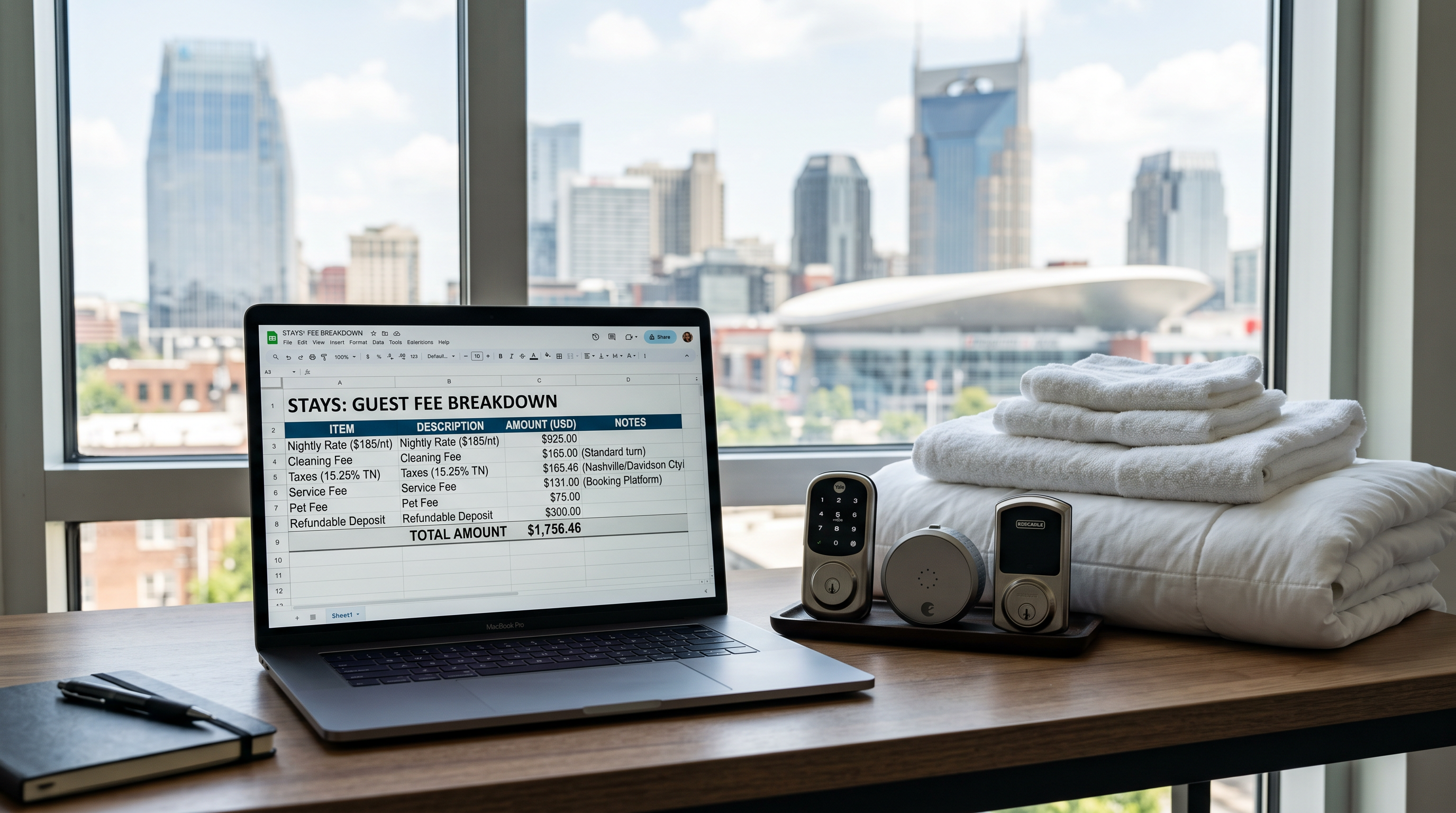
It is mid-July 2026, peak season is in full swing and many owners are renegotiating management contracts before the fall football bump. If your statement shows 18% while your neighbor pays 12%, that gap hurts. This guide lays out Nashville Airbnb management fees with clear math, what you actually get for each tier, and how to keep hidden line items from eating your returns on $40,000 to $90,000 properties.
Quick take
- Audit every fee line, then calculate the true, all-in take rate, not just the headline percent.
- Match service level to your asset, group-ready homes benefit most from full service executed well.
- Demand performance guarantees tied to dynamic pricing, response times, and review targets.
- Use real comp data to justify fees, not vague claims, April 2026 RevPAR was $187 per StaySTRA.
- Switch if your effective rate tops 20% with no measurable lift in ADR, occupancy, or reviews.
How Much Do Nashville Airbnb Managers Charge in 2026?
Across the market, co-hosting fees typically range from 10% to 15% of gross rent collected. Full-service programs usually run 18% to 25%, with some premium or remote homes quoted up to 30% when the provider fully handles staffing, consumables, and 24/7 field support. Local market reports this year show a wider spread than in 2024, as operators price more aggressively for high-touch service.
Headline percent is only the starting point. Ask what the percentage is applied to, gross booking revenue after taxes, or after subtracting cleaning and platform fees. Also clarify minimums per booking or per month, many contracts include a floor so the manager does not earn less than a stated amount in slow months.
Context for 2026 demand helps set expectations. April 2026 produced a $313 ADR and 59.7% occupancy for a $187 RevPAR per StaySTRA. Local market reports flagged a supply contraction that started in late 2025, which tightened comps for well-run, design-forward 3 to 5 bedroom homes.
Full-Service vs Co-Hosting: Fee Breakdown for Nashville STRs
Co-hosting is lean. You keep primary ownership of the listing and supply chain, and you pay a lower percent for pricing help, messaging, and limited on-the-ground coordination. It fits a townhome in The Nations where you live nearby and can restock between stays.
Full service is hands-off. The manager controls pricing, channels, cleaners, guest messaging, inspections, vendor dispatch, supply restock, and reporting. It shines for group-ready homes in 12 South, Germantown, or The Gulch, especially when high season compresses turnovers and the review stakes spike. Owners ask us about full service Airbnb management cost Nashville, and the honest answer is that the percent only makes sense when the operator’s systems consistently push ADR and occupancy above neighborhood comps.
If you are weighing co-hosting fees vs full service Nashville, map responsibilities line by line. Who buys linens, who pays for damaged items before reimbursement, who approves rates for CMA Fest week, who writes the listing, and who solves a 1 a.m. lockout. A clean responsibility matrix is worth more than a point or two on the fee.
Want examples of why your place might be lagging in bookings under a lighter service model, read our take on the why is my place not getting booked problem. It covers the commodity trap that hits smaller, undifferentiated units.
Hidden Fees That Inflate Your Nashville Management Cost
The fastest way to overpay is to ignore the non-headline items. Here are the common add-ons we see in owner statements and the typical range this year.
- Onboarding and listing setup: $250 to $1,000, confirm what is included, photography, copywriting, SEO, smart lock install.
- Professional photography: $300 to $700, great photos lift ADR, but you should own the assets.
- Linen and terry program: $15 to $25 per bed per turn, ask whether there is a markup or just a pass-through.
- Restocking consumables: either a flat per-turn fee or a 10% to 15% markup on supplies, clarify pricing and par levels.
- Maintenance coordination: $25 to $50 per work order, or a 10% vendor markup, watch for both showing up together.
- After-hours emergencies: per-call or per-hour surcharges, define what counts as emergency.
- Dynamic pricing software: $15 to $25 per month pass-through if not covered in the base fee.
- Owner support or accounting fee: $10 to $25 per month for statements or 1099 prep.
- Permitting and compliance management: a setup or annual fee, valuable if it includes reminders, documentation, and checklists.
- Credit card or payout processing: confirm whether platform fees are included in the manager’s percent or netted before the split.
- Marketing boosts: channel ads, featured placements, or social campaigns, ask who pays and how ROI is measured.
This is where hidden fees Nashville vacation rental managers do not headline can push a 12% quote to an effective 18% or more. Insist on a one-page exhibit that lists every potential fee, the trigger for it, and the dollar amount or formula.
Want to see what your property could earn? Use our free Nashville STR Revenue Calculator to get a personalized forecast and a fee-impact comparison.
What Is Included in Nashville Airbnb Management Fees?
Owners often ask what is included in Nashville STR management fee. At a minimum, a competent program should include dynamic pricing, calendar and channel management, 24/7 guest messaging with strict SLAs, cleaner scheduling and quality control, post-stay inspections, review management, and owner reporting.
Higher-performing teams also cover design direction, staging, mid-stay wellness checks, inventory control with barcode or QR auditing, and automated messaging sequences that reduce noise complaints and late checkouts. AI-driven rate setting that moves nightly rates 2 to 4 times a day and watches event calendars is now table stakes if you want to outperform neighborhood comps during CMA Fest, large conventions, or the late-season football surge.
Compliance is not optional. A good manager tracks your permit status, renewal dates, and guest limits. Start permit renewals at least 60 days before expiration and keep the required documents handy, proof of insurance, neighbor notifications where applicable, and safety items like smoke and CO detectors documented. For rules, use the Metro Codes page for Short Term Rental Property, then apply those requirements to your specific zoning and permit type.
Neighborhood logistics also change your cost stack. Cleanings for downtown or The Gulch condos trend higher due to parking and elevator time, for a similar 2 bedroom we see $130 to $180 downtown versus $120 to $150 in The Nations or Sylvan Park. City-center homes need more noise monitoring and guest verification tools, while townhomes near Germantown usually emphasize parking instructions and tailgate-friendly amenities.
Is 15% or 18% the Right Fee for Your Nashville Property?
The right answer is in the math. Here is how a 3 point gap affects annual owner proceeds at common revenue bands, assuming the same gross revenue.
- $40,000 gross, 15% fee equals $6,000, 18% fee equals $7,200, a $1,200 delta.
- $60,000 gross, 15% fee equals $9,000, 18% fee equals $10,800, a $1,800 delta.
- $90,000 gross, 15% fee equals $13,500, 18% fee equals $16,200, a $2,700 delta.
Now add performance. If the 18% operator consistently lifts your ADR and occupancy by a combined 8% through stronger pricing and better reviews, that same $60,000 home becomes $64,800. Your 18% fee is $11,664 but you net $53,136 before other expenses, $1,536 more than the 15% option at $51,000. In other words, a higher percent can be cheaper if it comes with measurable revenue lift and lower incident costs from tighter operations.
Flip it around. If your 18% program does not beat comps, and hidden line items push your effective rate above 20%, you are subsidizing someone else’s overhead. Ask for a 90-day performance audit tied to RevPAR versus a defined comp set and review velocity, then decide. If you want more tactics on lifting earnings quickly, this playbook on how to cut vacancy and raise ADR lays out practical wins.
How Management Fees Impact Your Nashville Annual Revenue
Seasonality and fee structure interact. January is the slowest month, local market reports put the average around $2,686, which means minimum booking floors and per-booking management minimums matter more. In peak months, often $5,932 on average, you want your fee covering aggressive pricing rules, last-minute gap fills, and extended-stay strategies that push RevPAR without overworking the team.
Think in RevPAR math. With April’s $187 RevPAR benchmark per StaySTRA, a 10 unit building doing 60% occupancy at a $300 ADR will not cut it if your fee plan does not include daily pricing adjustments, event calendars, and stay length mixes. Strong operators toggle 2-night weekends in shoulder weeks, flex to 3-night minimums for big events, and use AI to catch rate cliffs during midweek demand.
Costs are not static either. A condo in The Gulch with valet-only parking may bake in $10 to $20 per turn higher labor. A 4 bedroom in Hillsboro Village may need a quarterly deep clean and upholstery refresh to maintain review scores after bachelorette-heavy weeks. Your fee should reflect real field time and the tools required to run clean, fast operations.
If you are evaluating an offer this month, pressure test it against your asset’s calendar. Ask the manager to show last November through New Year projections for your comp set and the specific levers they will use to capture the late-season football demand spike without risking noise complaints.
When to Switch Your Nashville Property Manager Based on Fees
Consider a change if any two of these are true for 90 days or more. Your effective take rate, headline percent plus all add-ons, is above 20%. Your occupancy lags similar homes by more than 8 points, or your ADR trails by 10% or more. Your review count and average rating are flat or falling despite stable demand in your area. Or, you are paying 18% or higher without documented rate testing and event pricing plans.
Before switching, confirm who holds your permit and listing accounts. If your manager holds the listing, plan a 30 to 45 day transfer so you retain review history and Superhost status where applicable. For permits, know the difference between Type 1 and Type 2 and confirm your zoning limits and renewal steps on the Metro Codes site. If you need a deeper strategic view of 2026 opportunities and risks, our 2026 investor guide covers permits, returns, and automation in plain language.
What is the average Airbnb management fee in Nashville 2026?
Co-hosting averages 10% to 15% of gross rent, while full service often runs 18% to 25% for most homes. When owners ask about Nashville Airbnb management fees in 2026, the key is the all-in rate after pass-throughs and minimums. If your effective rate drifts past 20% without clear revenue lift, you are overpaying. To benchmark fairly, line up the exact services, pricing tools, and response SLAs.
How much does full-service short-term rental management cost in Nashville?
Most full-service contracts sit between 18% and 25% of gross rent. Some luxury or remote-location homes price higher due to staffing, concierge elements, and extended vendor coordination. Ask the provider to tie that premium to documented ADR, occupancy, and review gains over a defined comp set. If the higher percent does not come with measurable lift, it is just margin for the vendor.
Are there hidden fees in Nashville vacation rental management contracts?
Yes. Common add-ons include onboarding fees, photo packages, linen programs, maintenance coordination markups, dynamic pricing software pass-throughs, and accounting fees. These can push a 12% headline to an 18% effective rate if you do not cap or negotiate them. Request a one-page exhibit that lists every potential charge, its trigger, and the exact dollar amount or formula.
Is 15% or 20% a good management fee for Nashville Airbnb?
Fifteen percent is strong value if the operator delivers pro-grade pricing, fast guest messaging, and reliable turnovers. Twenty percent can still be a win when the team consistently beats comps and reduces wear, emergency calls, and cancellations. Use math, at $60,000 gross, 5 additional points cost $3,000 a year, so the manager must credibly add more than that to your top line or save that in avoidable costs. Always calculate the effective take rate, not just the headline number.
What services are included in Nashville STR management fees?
Expect pricing, calendar and channel management, 24/7 guest support, cleaner scheduling and inspections, restock processes, review management, and owner statements. Better programs add design, staging, inventory control, proactive maintenance scheduling, and compliance help. They should also monitor permit status and start renewals early to avoid gaps. Ask for written SLAs on response times and issue resolution.
How do co-hosting fees compare to full-service in Nashville?
Co-hosting trades a lower percent for more owner responsibility, you often handle supplies and some field work. Full service costs more, but it centralizes pricing, messaging, turnovers, and vendor management, which usually lifts reviews and ADR. Pick based on your asset and your time, a group home with tight event peaks usually outperforms under full service if the operator is strong.
Do Nashville Airbnb managers charge setup or maintenance fees?
Many do. Onboarding or listing setup can range from $250 to $1,000, and some charge $25 to $50 per maintenance work order or a 10% vendor markup. Clarify whether photography, smart lock install, and pricing software are included or billed separately. Get every potential fee in writing before you sign.
If you want a straight answer on what your place should earn at different fee tiers, run the numbers with our tool. Get your free Nashville revenue estimate. Ready for a deeper discussion about services, pricing rules, and compliance support, Schedule a call and we will walk your property, comps, and fee options without the fluff.