Nashville Type 2 STR Permits: Zones That Still Work In 2026
Discover which Nashville zones still allow Type 2 (NOOSTR) STR permits after only 30 closings near downtown. Get the full zoning list for commercial and…
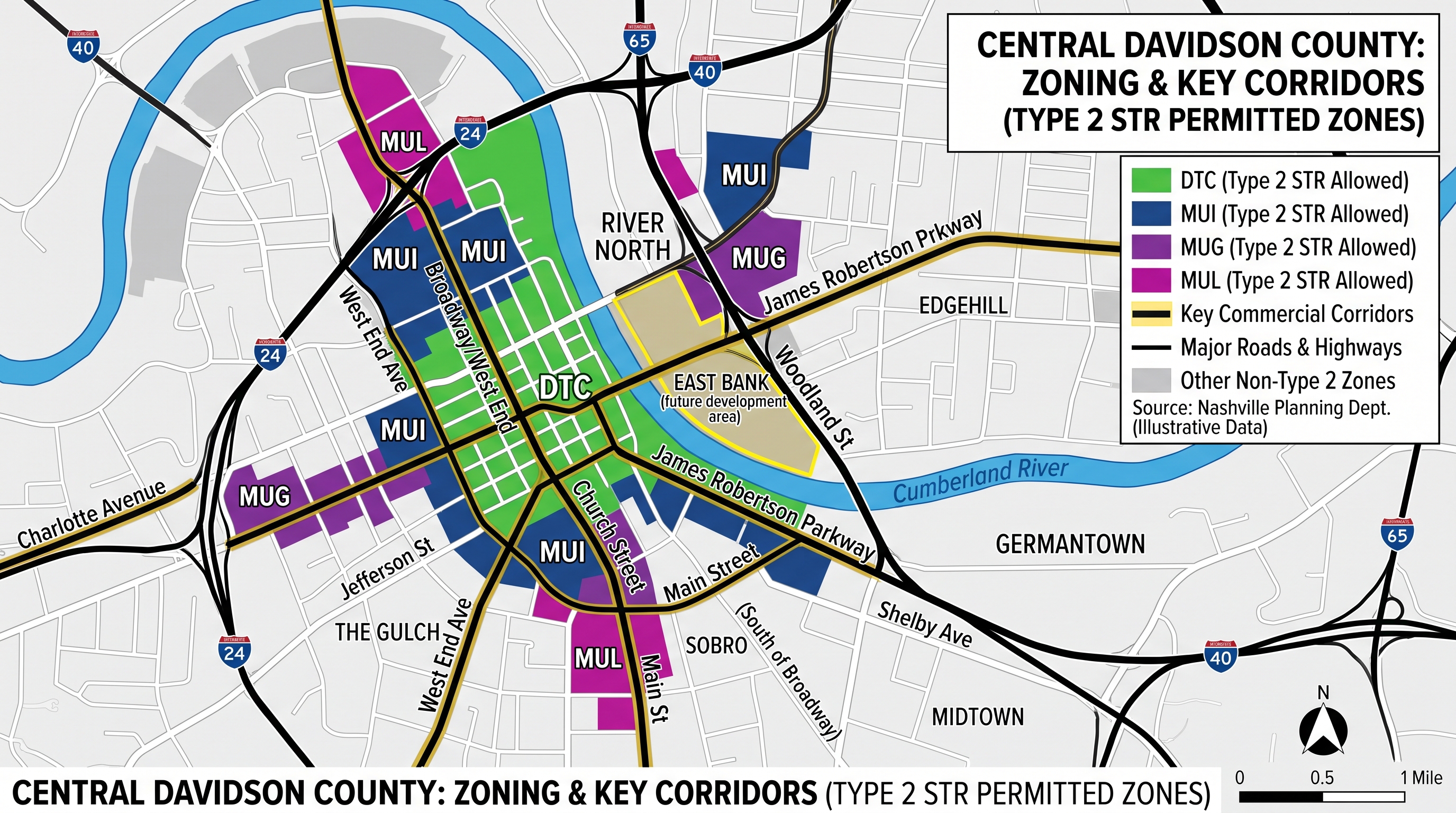
Peak summer is here, booking demand is healthy, and investors are scrambling to find parcels where a non-owner-occupied permit is actually possible. Through April 3, only 30 NOOSTR sales closed within 5 miles of downtown, a clear sign that supply is choked near the core. If you are trying to figure out which Nashville zones allow Type 2 STR permits, the viable map is now mostly commercial and mixed-use strips, plus a few SPs that explicitly allow it.
- Quick take: Target DTC and mixed-use or commercial bases like MUI, MUG, MUL, CS, CL, CA, CF, plus industrial districts where STRP is allowed, and SPs that list NOOSTR as a permitted use.
- Avoid buying Type 2 in residential bases: R, RS, and RM do not issue new non-owner-occupied permits.
- Verify the parcel in writing: Check base zoning, overlays, SP text, building type, and HOA bylaws before you go under contract.
- Read the market: AirDNA reports 13,898 active listings and average annual revenue of $40.9K as of June 2026, while StaySTRA shows April occupancy at 59.7 percent with ADR at $313.
- Follow development gravity: East Bank projects like the Titans stadium and River North are shifting demand toward Dickerson, Germantown edges, and the urban core.
Understanding the NOOSTR Permit Crunch in Nashville 2026
The permit path for a true vacation rental unit has narrowed. Local market reports put active STR permits around 3,700 across Davidson County in 2026, and new non-owner-occupied approvals are effectively limited to non-residential zoning. A mid-year snapshot from AirDNA shows 13,898 active STR listings and $40.9K average annual revenue per listing, which means plenty of demand still exists, but accessing it now depends on zoning, not just underwriting.
Seasonality and booking behavior make the permit decision even more critical. StaySTRA tracked April 2026 occupancy at 59.7 percent, up 4.86 points year over year, while ADR dipped to $313, a 6.26 percent decline, reflecting heavier competition on price during shoulder weeks. Booking windows have shortened materially compared to pre-2020 norms, so investors need a location that can win last-minute demand from major events and corporate travel, not just bachelorettes on weekends.
On the acquisitions front, the pool is thin near the core. Only 30 NOOSTR properties closed within a 5-mile radius of downtown through April 3, 2026, according to a market report published in April 2026. That figure speaks to two realities, many residential sellers are now off-limits to Type 2 buyers, and the few legal parcels command a premium.
Which Zoning Districts Still Allow Type 2 STR Permits
Today, NOOSTR is a use you can still secure in many commercial and mixed-use districts, in portions of the Downtown Code, in select industrial districts, and in SPs that explicitly list it. Below is a practical, operator-focused view of where we still see approvals proceed when all other conditions are met. Always verify with Metro Codes and the adopted ordinance for your parcel.
- Downtown Code (DTC): Allowed in many subdistricts when the use table permits it. Think SoBro and Gulch edges, parts of Capitol View and Parliament. If you are hunting for a DTC zone short term rental permit, confirm the subdistrict and street frontage rules.
- Mixed-use bases: MUI, MUG, MUL, and, in some contexts, MUN. These are the workhorses along Charlotte Avenue, Dickerson Pike, and Gallatin corridors. We see the cleanest outcomes in MUI and MUG for larger buildings and MUL for townhome or mid-scale product. This is the heart of the MUL MUG MUI zoning Nashville STR permits conversation.
- Commercial bases: CS and CL are common, with CA and CF present in pockets. Strip center outparcels, corner lots on arterials, and legacy commercial parcels can qualify if no overlay blocks the use.
- Office bases: OR family districts sometimes allow it, but these often sit near residential fabric, so overlays and SPs can change the answer. Read the table.
- Industrial: IWD, IR, and IG can work if the site meets life safety and building type standards, and if there is a guest-friendly environment around it.
- Specific Plan (SP): Only when the adopted SP ordinance explicitly lists Short Term Rental Property, non-owner occupied, as a permitted use and does not remove it by amendment.
Every one of these has caveats. Urban design overlays, historic overlays, MDHA redevelopment districts, floodplain, and site-specific SP language can override the base district. Before you model yields, validate the actual use permissions on the parcel.
Want a deeper market view while you shortlist legal parcels? Read our 2026 investor guide for returns and permitting strategy in the current cycle in this 2026 investor guide.
Want to see what your property could earn? Use our free Nashville STR Revenue Calculator to get a personalized forecast. Get your forecast here.
Why Residential Zones Are Blocked for Non-Owner-Occupied STRs
The residential base districts, R and RS for single-family and RM for multifamily, do not issue new Type 2 permits. That policy choice pushed NOOSTR into non-residential areas to reduce friction with neighbors and preserve long-term housing. If you plan to operate in a residential setting, your path is a Type 1, owner-occupied permit, which has different rules.
Metro publishes current standards and application steps, and you should confirm any updates directly with Codes. Start here and follow the links to permits and FAQs on the city site: Metro Codes Short Term Rentals.
How to Verify If Your Property Qualifies for a NOOSTR Permit
Lock this down before you put down earnest money. Here is a no-nonsense process that works.
- Pull the base zoning and overlays: Use the parcel viewer or a zoning letter to confirm the base district and any overlays. Screenshots are not enough, get source documents.
- Check the use table: Look up whether Short Term Rental Property, non-owner occupied, is a permitted use in your base district or DTC subdistrict. If you are in DTC, the subdistrict matters as much as the base.
- Read the SP ordinance if applicable: If the parcel is SP, download the adopted ordinance. If NOOSTR is not listed as a permitted use, assume it is not allowed.
- Confirm building type and life safety: Some approvals hinge on sprinklers, egress, occupancy limits, and commercial code compliance. Do not assume a townhouse can be treated like a hotel unit.
- Check HOA and private restrictions: Even if Metro allows it, an HOA can prohibit STRs. Get the CC&Rs and any amendments in writing.
- Call Codes to validate your reading: A five-minute call can save a blown contract. Document who you spoke with and the date.
- Underwrite conservatively: Model ADR and occupancy using current data, not pandemic highs. AirDNA’s market overview and StaySTRA’s monthly metrics are solid starting points.
For a step-by-step play on revenue optimization once permitted, see our operator checklist in this 2026 management success guide, and troubleshoot demand gaps with this booking diagnostics article.
Top Mixed-Use Zones in Nashville for STR Investors
Not all mixed-use is equal. Corridor context, walkability, and upcoming projects matter as much as the letters on the map.
MUI and MUG near the core
These are the most flexible for larger projects and urban townhomes. We like edges of SoBro and The Gulch that sit outside the heaviest hotel clusters but still serve Broadway, Bridgestone events, and convention traffic. Expect higher land prices, but also stronger weekday demand from business travel as East Bank offices and stadium activity ramp up.
MUL along arterials
MUL shines for mid-scale product along Charlotte Avenue by Sylvan Park and in The Nations, or along Gallatin Pike approaching East side activity. Townhome clusters with garage parking and 3 to 4 bedrooms do well with group travel. Proximity to new food and beverage, plus quick access to the core, is the revenue driver.
Dickerson and River North adjacency
As the Oracle River North campus takes shape and the Titans stadium progresses on the East Bank, the north-of-downtown arc keeps gaining attention. Look for MUG and MUI parcels with skyline views, quick rideshare access, and low-friction site planning. The payoff is year-round demand that is less dependent on weekend spikes.
WEHO and industrial edge plays
Wedgewood-Houston has a patchwork of SPs, IWD, and mixed-use. The opportunity is in creative product that taps into art galleries, new venues, and the stadium corridor without paying Gulch pricing. Verify every parcel here, SP language can flip a yes to a no.
From a revenue lens, StaySTRA’s April occupancy at 59.7 percent and ADR at $313 illustrate a stable baseline, while AirDNA’s $40.9K average annual revenue shows the median property still has room to run with design-forward layouts and group-friendly amenities near venues and transit.
The Role of Specific Plan (SP) Districts in STR Permitting
SPs are custom zoning. The only way to know whether NOOSTR is allowed is to read the adopted ordinance for your parcel. Some SPs adopted years ago list Short Term Rental Property, non-owner occupied, as a permitted use. Others are silent or have been amended to remove it. Silence usually means no.
Two rules of thumb, never assume an SP inherits permissions from a neighboring base district, and never rely on a listing agent’s summary. Ask for the ordinance number, pull the PDF, and search for Short Term Rental in the use chart or conditions. If it is not there, plan on a different strategy.
Common Mistakes When Applying for a NOOSTR Permit in Nashville
- Chasing residential parcels: R, RS, and RM bases do not issue new Type 2 permits. No amount of design or revenue will change that.
- Ignoring overlays: A base district that allows NOOSTR can be voided by an overlay or redevelopment district. Always check both.
- Assuming any SP will work: Only SPs that explicitly list the use permit it. If the text is silent, plan on no.
- Forgetting HOA rules: An HOA can prohibit STR regardless of Metro permissions. Get CC&Rs before you waive contingencies.
- Underwriting on old comps: Average daily rate and lead time have shifted. Price modeling must reflect shorter booking windows and event volatility.
- Skipping life safety: Egress, alarms, and occupancy limits can kill a permit in buildings not built to commercial standards.
- Not documenting due diligence: Keep emails, zoning letters, and call notes. You will need them if staffing or policies change at Codes.
What zoning allows non-owner-occupied STR permits in Nashville?
The fast way to tell which Nashville zones allow Type 2 STR permits is to start with commercial and mixed-use districts, including DTC subdistricts that permit the use, mixed-use bases like MUI, MUG, and MUL, commercial bases such as CS and CL, industrial districts like IWD, and SPs that explicitly list NOOSTR as permitted. Residential bases R, RS, and RM do not issue new Type 2 permits. Always confirm on the Metro Codes site and by reading any SP ordinance for the parcel.
Can I get an Airbnb permit in a residential zone in Nashville?
Not for Type 2. New non-owner-occupied permits are not issued in residential bases like R, RS, or RM. If the home is your primary residence, explore a Type 1 permit, which has different standards and occupancy rules.
Which mixed-use zones in Nashville allow Type 2 STR permits?
MUI, MUG, and MUL are the primary mixed-use bases where we still see approvals when no overlay blocks the use and building code requirements are met. MUN can work in limited contexts but needs closer review. For parcels in the Downtown Code, confirm the subdistrict use table.
How many NOOSTR permits closed near downtown in 2026?
Only 30 non-owner-occupied properties closed within a 5-mile radius of downtown through April 3, 2026, according to a market report published in April 2026. That low number underscores how scarce legal inventory has become near the core.
Is MUL zoning good for short-term rentals in Nashville?
Yes, when sited on strong corridors. MUL is productive for mid-scale townhome and small multifamily projects near venues and food and beverage, for example along Charlotte Avenue or Gallatin Pike. It provides flexibility without the intensity and price of MUI, but you must confirm overlays and site standards.
What is the difference between Type 1 and Type 2 STR permits?
Type 1 is owner-occupied, typically your primary residence with limits on how many days or rooms you can rent. Type 2 is non-owner-occupied, essentially a dedicated vacation rental in eligible zones. The application requirements, allowed zones, and renewal risks differ, so verify which path fits your property and goals.
Do HOAs override Metro Codes for STR permits?
Yes, an HOA can be stricter than the city. If HOA governing documents prohibit STRs, you cannot operate even if zoning and Codes would otherwise allow it. Always obtain and read the CC&Rs and amendments before you waive contingencies or close.
Serious about moving forward on a legal, high-performing asset? Get a data-backed view of returns and compliance next. Get your free Nashville revenue estimate, or Schedule a call to review zoning, revenue comps, and an operations plan for your specific address.
Sources cited: AirDNA Nashville overview for active listings and revenue, StaySTRA market page for occupancy and ADR, April 2026 market report for the 30 NOOSTR figure, and Metro Codes Short Term Rentals for current permit rules.
Related: See more Nashville STR insights.
Next step
If you want a risk-aware plan for permits, pricing, and operations in Nashville, I’ll walk you through it quickly and candidly.